AMX FIGHTER, BRAZIL / ITALY
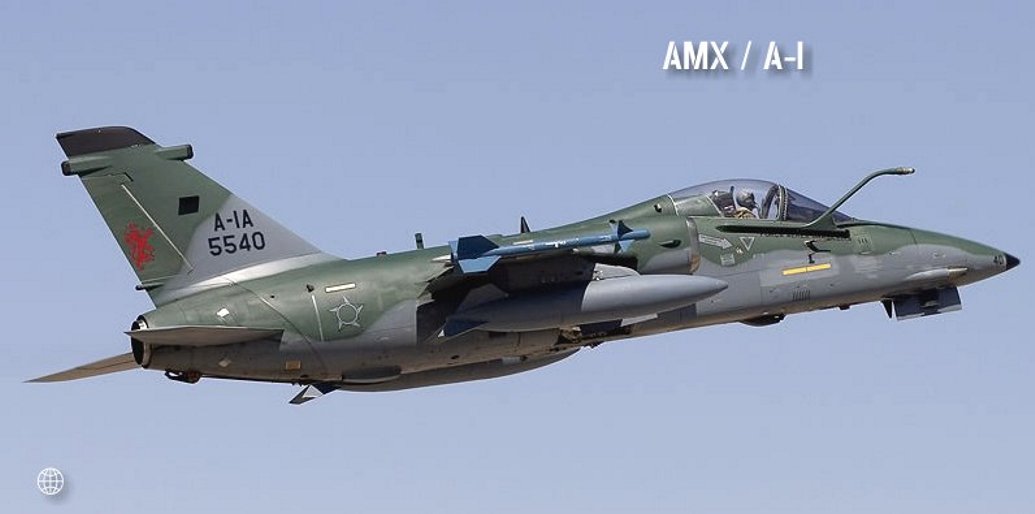
The AMX fighter-bomber aircraft is in service with the air forces of Brazil, Italy and Venezuela. The first AMX aircraft was delivered to the Italian Air Force in January 1989 and to the Brazilian Air Force in 1990. Production involved assembly lines in Italy and Brazil. In total, 192 aircraft, 155 single seater and 37 AMX-T two seater, have been delivered to Italy (110 AMX, 26 AMX-T) and Brazil (79 AMX, 15 AMX-T)
The AMX programme originated from a requirement of the Italian Air Force for single-seater and two-seater combat aircraft for surface attack missions. In 1982 a Memorandum of Understanding was signed by Italy and Brazil and the joint development and production programme was subsequently conducted by AMX Consortium, based in Rome, through the Italian companies Alenia Aerospazio, now Alenia Aeronautica, (46.5%) and Aermacchi (23.8%) and the Brazilian company Embraer (29.7%).
The main role of the AMX is ground attack in visual and marginal weather conditions, with primary roles in long range strike and air interdiction, close air support, reconnaissance and armed patrol. The aircraft is also highly effective in air defence missions and the lead-in fighter role. Italian Air Force AMX fighters were deployed as part of the NATO forces in Operation Allied Force against Serbia in 1999.
In December 2002, the Venezuelan Air Force signed a contract with Embraer for 12 AMX-T Advanced Training and Tactical Support Aircraft. Deliveries are to begin in 2005. The upgraded AMX-T is designed as an advanced trainer and lead-in fighter and has a digitised cockpit and new avionics.
In August 2004, the Brazilian Air Force signed a contract with Embraer for a mid-life update of 53 single-seat (designated A-1A) and two-seat (A-1B) aircraft. The upgrade will include three new multifunction colour displays, head-up display, night vision goggle compatibility and new communications / navigation suite. Elbit of Israel is to be the lead contractor.
In February 2005, the Italian Air Force selected Alenia Aeronautica to upgrade 55 AMX aircraft with new avionics, including INS/GPS navigation system, new communications systems and IFF (Interrogation Friend or Foe), new displays and the addition of a capability to deploy smart munitions such as the Boeing Joint Direct Attack Munition (JDAM). First flight of the upgraded aircraft was in September 2005.
CONSTRUCTION
Alenia manufactures the central section of the fuselage, the nose radome,
the ailerons and spoilers and the tail surfaces. Aermacchi is responsible
for the forward fuselage, the integration of the gun and avionics, the
canopy, and the tailbone. Embraer is responsible for the air intakes,
the wings, the leading edge slats and flaps. Embraer is also responsible
for the wing pylons, the external fuel tanks and the reconnaissance pallets.
Final assembly is carried out in both Italy and Brazil.
AMX-ATA
The AMX Advanced Trainer Attack (AMX-ATA) is a new AMX two-seater, multi-mission
attack fighter for combat roles and advanced training. The AMX-ATA incorporates
new sensors, a forward looking infrared, helmet-mounted display, a new
multi-mode radar for anti-air and anti-ship capability, and new weapon
systems including anti-ship missiles and medium-range missiles. The Venezuelan
Air Force ordered eight AMX-ATA in 1999 for the advanced trainer and attack
aircraft role.
WEAPONS
SYSTEMS
The AMX's computerised weapon aiming and delivery system, supplied by
Alenia, includes the radar and the stores management system.
The AMX can carry external loads up to 3800kg. The aircraft has seven hardpoints: one on the centreline of the underside of the fuselage, two hardpoints under each wing and wingtip rails on each wing. The aircraft can carry air-to-air missiles, air-to-surface missiles, free-fall bombs, retarded bombs, laser-guided bombs, cluster bombs, precision-guided munitions and rocket launchers. Italian Air Force AMX aircraft have been equipped with GBU-12 bombs, fitted with the Opher imaging infrared terminal guidance kits supplied by Elbit of Israel. The wingtip launchrails can carry the AIM-9L infrared guided Sidewinder air-to-air missile, or the Orbita MAA-1 Piranha air-to-air missile.
Italian AF AMX are being armed with Lizard laser-guided bombs from Elbit. The bombs have 500lb Mk 82 warheads. The US JDAM Joint Direct Attack Munition is also being fitted on the Italian AMX.
Italian AF AMX are to be supplied with Lizard laser-guided bombs from Elbit. The bombs will be armed with 500 lb Mk 82 warheads. From 2003, it is planned that the US JDAM Joint Direct Attack Munition will also be carried on the Italian AMX.
COUNTERMEASURES
The aircraft is equipped with an active and passive electronic countermeasures
system supplied by Elettronica. The radar warning receiver is mounted
in the tail fin.
COCKPIT
SYSTEMS
The pressurised and air-conditioned cockpit is fitted with a Mark 10L
zero ejection seat developed by Martin-Baker, based in Uxbridge, UK. The
cockpit's environmental control system is supplied by Microtecnia. The
single-piece wrap-around windscreen and single-piece canopy give the pilot
a very clear view of the airspace and also a forward-downward view of
18° over the nose. The cockpit is night-vision goggle (NVG) compatible.
The cockpit is equipped with an Opto Mechanik, Inc. and Alenia head-up display and an Alenia multifunction head-down digital data display.
AVIONICS
SYSTEMS
The avionics systems are pallet mounted for fast and efficient access
for service and maintenance. The modularity of the systems allows alternative
or upgraded systems to be installed.
The aircraft is equipped with UHF and VHF communications and an identification friend or foe (IFF) interrogator.
RADAR
SYSTEMS
The Italian Air Force AMXs are equipped with a variant of the EL/M-20001B
radar, operating at I-band. Fiar in Italy manufactures the radar, which
is designed by Elta in Israel. The AMX in operation with the Brazilian
Air Force is equipped with the Fiar/Tectelcom SCP/01 radar. Venezuelan
AF planes are expected to be fitted with Elta EL/M-2032 radar.
RECONNAISSANCE
SYSTEMS
The aircraft retains its normal level of self defence and attack capabilities
when it is equipped for reconnaissance missions. The camera bay, just
forward of the mainwheel bay on the starboard side, can hold the pallet-mounted
photographic reconnaissance systems supplied by Aeroeletronica of Brazil.
An electro-optical infrared pod can be carried on the pylon on the centreline of the fuselage. For reconnaissance and battle damage assessment, the electro-optical and infrared system is being equipped with digital recording and a data link.
A number of AMX aircraft in service with the Italian Air Force have been fitted with the Oude Delft reconnaissance pod.
ROLLS-ROYCE
TURBOFAN ENGINE
The aircraft is powered by the Rolls-Royce Spey Mark 807 non-afterburn
turbofan engine, which develops 49.1kN. The engines are built under a
licensed manufacturing agreement by Alfa Romeo Avio, Fiat and Piaggio
in Italy, and by Companhia Electro-Macanica in Brazil. A Fiat FA 150 Argo
auxiliary power unit is used for starting the engine.
The aircraft carries 3,500l of fuel in internal tanks, which gives a mission attack radius of typically 550km with a five-minute combat time over the target area. The internal tanks are self-sealing rubber bag tanks in the fuselage and two integral wing tanks. The ferry range is extended to 4,000km, with two 1,100l and two 580l auxiliary fuel tanks carried on the wing pylons. The range and endurance time are also extended by in-flight refuelling, using a probe and drogue inflight refuelling system.